David Brooks, popular op-ed contributor to The New York Times, manages to write about things political and things spiritual at one and the same time. In "In Praise of Equipoise," he wonders about what it is that determines who or what we most identify with in this, our contentious time of verbal brickbats being endlessly hurled back and forth at each other.
Amin Maalouf
Brooks quotes the Lebanese-born writer Amin Maalouf: "People often see themselves in terms of whichever one of their allegiances is most under attack." We see ourselves primarily as individuals who are subject to victimization by other individuals who say they hate us. We resent being "disrespected for being a Jew, a Christian, a liberal or a conservative," or whatever other label our opponents attach to us, and so we join with others being maligned with the same label, and we fight back. "Today, the world feels like a hostile environment to. … well … everyone."
Brooks adds, "Group victimization has become the global religion — from Berkeley to the alt-right to Iran — and everybody gets to assert his or her victimization is worst and it’s the other people who are the elites." This is the exact opposite of what true religion is supposed to do. As the etymology of the word indicates, religion is meant to bind us together, not tear us apart.
Religion was designed to promote community — which is why one of the principal rites of Christian churches everywhere is called "Holy Communion." But today, what passes for the erstwhile ideal of the big-tent community is actually just an "identity community." Yet these social groupings are, says Brooks, "not even real communities. They’re just a loose group of individuals, narcissistically exploring some trait in their self that others around them happen to share. Many identity-based communities are not defined by internal compassion but by external rage."
So we have today a society that spirals centrifugally outward, away from its vital center, rather than centripetally inward toward a sense of cohesive unity. It's a spiral of death, not life. "How do we get out of this spiral?" Brooks asks.
Step 1: "Turn the other cheek, love your enemy, confront your opponent with aggressive love." It's what Jesus taught, it's what Buddha taught, and it's still true today.
Step 2: Don't allow yourself to be defined by a single label affixed on you by someone who hates you. Don't attach yourself just to your label mates. Know instead that "the heart has many portals. A healthy person can have four or six vibrant attachments and honor them all as part of the fullness of life."
Step 3: Be a person with equipoise. "The person with equipoise doesn’t feel attachments less powerfully but weaves several deep allegiances into one symphony." It's all about staying in balance. "Achieving balance is an aesthetic or poetic exercise, a matter of striking the different notes harmonically. ... [S]how me a person who can gracefully balance six fervent and unexpectedly diverse commitments, and that will be the one who is ready to lead in this new world."
Today, as at every Sunday Mass at Church of the Resurrection in Ellicott City, Maryland, there came a point in the liturgy when the cantor sang, "The mystery of faith," and the congregation immediately replied, "We proclaim your Death, O Lord, and profess your Resurrection, until you come again."
To me, this rather strange-sounding affirmation, even though it's a statement of faith that has the notion of death so prominent in it, offers the ultimate in hope. Here's my attempt to say why.
Heather Heyer
Let me begin by noting that our culture today seems to have crossed a dangerous line into chaos. This was recently brought home to me by the tragic death a bit over a week ago of Heather Heyer in Charlottesville, Virginia. She was the victim of an automobile driven intentionally into a crowd of anti-protesters at a rally of white supremacists, one of whom was the driver of the vehicle.
Her martyrdom was a sign of cultural chaos, the seeming coming apart of America. America seems to have become a country where the center no longer holds.
I've long been interested in the sciences of complexity and chaos. Their recent additions to the pantheon of scientific insights tell us that a human culture is a "complex adaptive system." Like all other such systems, it can exhibit any of four classes of behavior. One of these classes is chaos.
"Chaos" describes a system in such flux that its future is intrinsically unknowable. It changes constantly — not in itself a bad thing — but as a chaotic system changes from one state to the next to the next, none of the novelty it has produced remains intact. As a wag once put it about human history, the arc of its history is meaningless: "just one damn thing after another."
"Order," the opposite of chaos, is represented by two of the four classes of states a complex system can be in. In one of those two classes, the state of the system is completely static. Nothing ever changes, like when a marble sits stationary in the bottom of a bowl.
In the second of those two classes of systemic order, the marble in effect circles around and around in an orbit near the lip of the bowl. True, there's change of a sort, like when a planet circling a star experiences an ever-repeating succession of seasons. Yet there's never really "anything new under the sun."
The fourth class of complex systems' behavior is the most interesting. It's been dubbed the "edge of chaos." At the edge of chaos, creation (in the form of evolution) occurs:
This means that at the edge of chaos, meaningful change happens — not the meaningless, ephemeral change of chaos per se. New things come into existence and then stick around, adapting to changing circumstances and gracefully evolving into yet newer things.
That's how our species, Homo sapiens, arose on this earth.
The thing is, edge-of-chaos behavior in a complex system can be jostled over into the realm of chaos per se. Chaos-inducing perturbations can come from outside the system, but they can also come from within the system itself.
Complexity scientists have shown, however, that being jostled over into the realm of chaos is not necessarily a death sentence. Complex adaptive systems can instead do just what their name suggests: adapt. In doing so, they can pull themselves out of their tailspin and migrate their systemic behavior back over to the fecund edge of chaos.
When sentient beings do this, one expression we have for it is "learning from our mistakes." We don't usually think of a whole society or culture as a sentient being, but a society or culture can also learn from its mistakes.
One of the mistakes this society made in the past was slavery. Now we see individuals and governments moving to take down monuments to Civil War heroes of former slave states. This movement represents a beneficial adaptation that comes in response to the recent efforts of racists and white supremacists to reassert what they see as having been White America's past glory.
We now have a case, accordingly, of a movement along the moral arc of the universe — “The arc of the moral universe is long, but it bends toward justice,” President Obama once said, quoting Dr. Martin Luther King — provoking chaos in the form of an often violent counter-movement of neo-Nazis, thugs, and racists.
The mutual antipathy brings on chaos because it at least temporarily pulls us irreconcilably apart. So is our current political chaos going to end the American Dream? No, I say. Instead, we're going to find our way back to the fecund edge of chaos.
The reason I believe in this marvelous outcome is summed up in the "mystery of faith" I quoted at the beginning of this post. That the Lord Jesus Christ died and was resurrected is symbolic of the ability of the created order to be rescued, and even to rescue itself, from chaos. That the Lord will come again is furthermore symbolic of the fact that God's creation will never lose its capacity for righteous regeneration.
Pierre Teilhard de Chardin was one of the great Christian thinkers of the 20th century. He was a Catholic priest, a member of the Society of Jesus. He was also a leading paleontologist, geologist, and expert on biological evolution.
One might think that the scientific work of this great Frenchman was contradictory to his Christian faith, in that the theory of evolution seems to contradict the biblical account of creation in the book of Genesis. But Teilhard recognized that the seeming contradiction was a false one. He wrote several books about the subject. The overarching theme of these books was that sciences of evolution, properly understood, were testimony to the reality of Christian hope.
(How do you say his name? "pee-YARE tay-ARE duh shar-DAÑ" comes close. The final "Ñ" is nasalized. "Teilhard" is his surname, by the way, not "Chardin.")
Teilhard saw the evolution of life on Earth, culminating in our species of conscious living beings, as a crucial part of the development of the universe. It reveals the hidden pattern in cosmic history. Everything is converging! Instead of simply collapsing, instead of just dissolving in an outward direction, instead of moving ineluctably toward the nothingness physicists speak of as entropy, it is, in a more complex and esoteric way, moving inward. History, said Teilhard, is converging toward a central, cosmic resolution.
Calling it the "Omega Point," he identified this beneficent culmination of all cosmic history with Christ. Omega is the last letter of the Greek alphabet, and the New Testament was written in Greek. The New Testament, at its culmination in the book of Revelation, speaks of the "Second Coming" of Christ. For Teilhard, this Second Coming was the convergence of all cosmic history into one supernal Omega Point.
Philosophers seek to know the "absolute," and theologians identify God with the absolute. Teilhard identified the absolute with Christ as the Omega Point of the history of Creation.
Rather than being just some cold, impersonal abstraction, the Omega Point, said Teilhard, is personal and loving. And it is "supremely present" to us in the here and now. As conscious, intelligent creatures, we who are all already "in Christ" can knowingly participate in the convergence of cosmic history toward the Omega Point.
Wednesday, August 16, 2017: Today marks the 40th anniversary of the day Elvis Presley died, much too young, at age 42.
Elvis was not the first white performer to have a number one record on the Billboard R&B charts — that honor seems to have gone to, of all things, the record "White Christmas," sung by Bing Crosby in 1942 — but Mr. Presley placed fully 35 records on those R&B charts. Most of the artists on those charts, down through the years, have been African American.
Elvis's five #1 R&B records were legendary: "Hound Dog," "Don't Be Cruel," "All Shook Up," "(Let Me Be Your) Teddy Bear," "Jailhouse Rock," "Wear My Ring Around Your Neck."
Elvis was the first white man to come reasonably close to singing in the soulful manner a black man always could. He bridged the racial divide in a way few others could back in the 1950s, '60s, and '70s.
In 1968 he sang "If I Can Dream":
In 1969 came "In the Ghetto":
In today's Washington Post is an op-ed by Gary Abernathy, publisher and editor of the Times-Gazette in Hillsboro, Ohio. The piece is titled "Elvis’s death was a perfect example: The media doesn’t understand Middle America." In the American Heartland, back then in 1977, the passing of the King of Rock 'n' Roll was stunning news, Mr. Abernathy says. But to most of the editors and commentators in big-city news outlets, no.
One TV network led off its August 16, 1977, evening news program with a story about President Gerald Ford’s endorsement of the Panama Canal treaty, for instance. Today, I ask you, which story seems more epochal, Elvis's death (and the way the news media missed its importance to millions of Americans back then) ... or the Panama Canal? Mr. Abernathy sees the answer as pretty obvious.
Mr. Abernathy's approach strikes me as, in spirit, quite a Christian one. He wants to show what the memory of Elvis means to us now: a help in healing differences between the bulk of Americans on the two coasts, on the one hand, and many in the South and the Heartland on the other. I think there's nothing more Christian than to work to settle human differences in a just manner. And how interesting it is that Mr. Abernathy's current effort to build needed bridges in America echoes the bridge-building between whites and blacks that Elvis himself did, way back in his day 40 years ago!
In "The Mysterious Power of Setting Aside Differences," I talked about how I interpret the teachings of Jesus as guiding us toward a mysterious truth: We are better off both individually and as a society if we can find a way to bridge our differences.
The sciences of chaos and complexity help confirm this. Here's a brief rundown on why.
A human society is what scientists and mathematicians call a "nonlinear dynamical system." As such, it generally operates in an orderly way, although certain things can push it over into chaos.
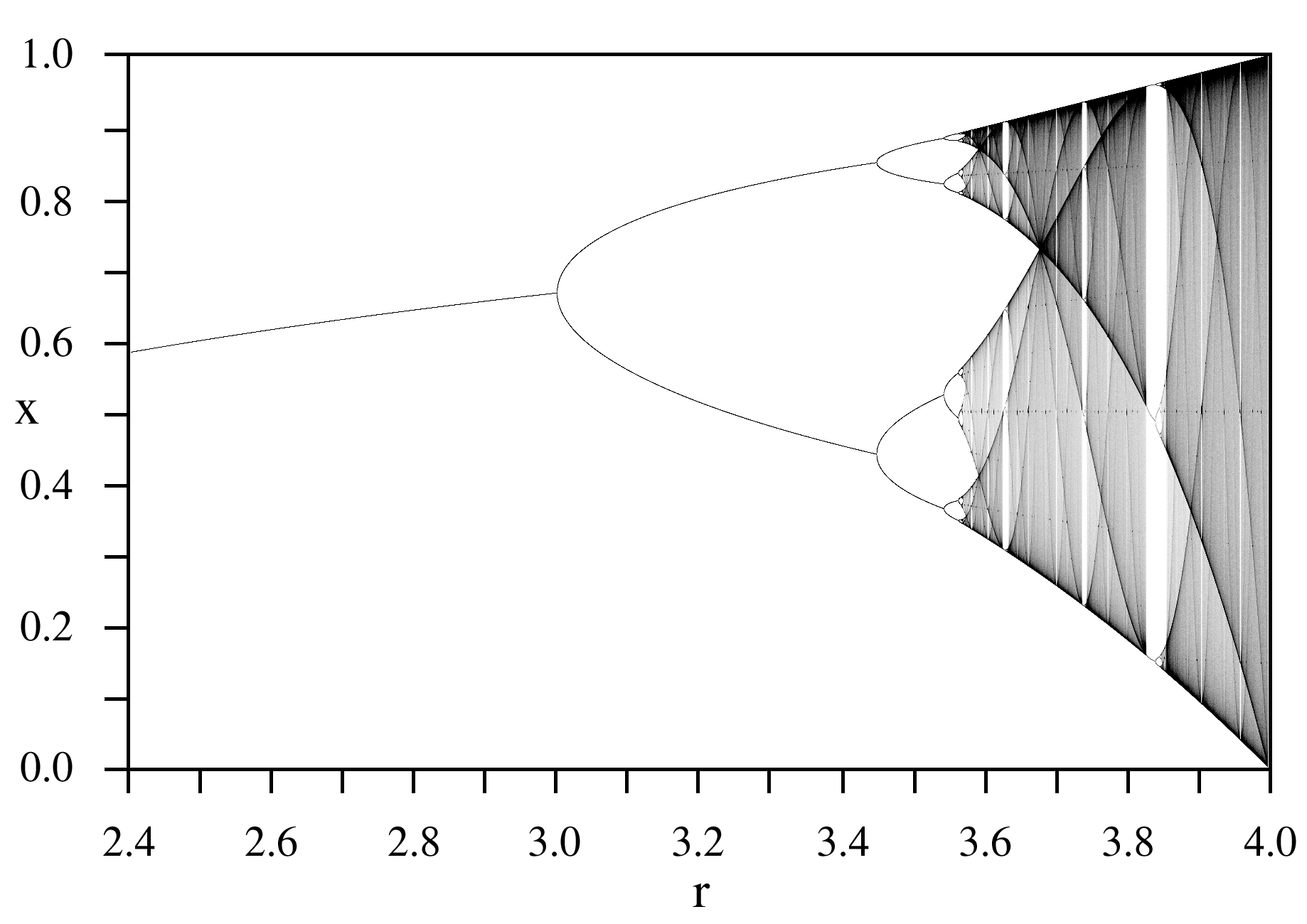
Here's a drawing, called a "bifurcation diagram," that appears in James Gleick's book Chaos. The book is a layman's intro to chaos theory. Gleick shows how nonlinear systems can be pushed from a orderly state into chaos. This bifurcation diagram illustrates how this can happen:
Look at the bottom axis, labeled r. r represents numbers that increase from 2.4 on the left to 4.0 on the right. The vertical axis, x, represents a value that depends on r and changes over time as r itself changes.
If r gets too big for whatever reason, the orderly behavior represented on the left of the diagram for values of r that are less than about 3.6 deteriorates. Here in the r >= 3.6 area we see the onset of chaos. The dark areas to the right of the diagram are simply graphical illustrations of what chaotic behavior looks like.
Notice that as r goes up — starting at about the value 3.0 — the orderly part of the diagram begins to "bifurcate." It splits, then splits again, then again. We're entering the region where chaos is imminent. If r continues to ascend, chaos is inevitable.
We're in that perilous region right now in America.
Think of "bifurcation" as what happens when different parts of a system begin to split apart in response to some external or internal stimulus. This splitting apart is the opposite, in the world of scientific abstractions, of "setting aside our differences" in the practical world. It represents the rise of disunity, not unity.
As disunity rises, chaos looms. I think the healing message of Jesus in the New Testament was intended by him as an antidote to societal and personal chaos in human affairs.
Even so, as I said in the earlier post, it's so difficult to see the sense of that wisdom, is it not? We're currently reeling from the news of a killing at a Charlottesville, Virginia, rally involving a white supremacist plunging his car into a group of counter-protesters, killing one and injuring several. White supremacism, the KKK, neo-Nazi belief — they're all as wrong as wrong can be. But I think a lot of the reaction to the Charlottesville tragedy, among conservatives and especially among progressives, has been to curse the darkness — represented in large part by lambasting President Trump's failure to impugn white supremacism expressly in his initial comments — rather than to light a candle.
We who hate what they espouse need to dialogue with white supremacists, not cast them into outer darkness. Dialogue heals. Dialogue moves us away from the onset of chaos.
True as that may be — and I believe it is true — seeking dialogue with KKK'ers feels like the last thing most of us want to do in the wake of Charlottesville, right? Maybe we should follow the example of Daryl Davis, a black musician I recently took a lecture course from. Daryl has spent years befriending KKK people and nudging them (often successfully) in the direction of his mantra: "How can you hate me if you don't even know me."
It's been dialogue that has allowed Daryl and his (yes!) friends in the KKK to get to know and even like one another. Here's a video about that:
(Notice that it's also a video about how music can serve as a "common denominator" between blacks and whites. I'm currently in the process of developing a course I'm calling "Ebony and Ivory" that I hope will show that common denominator in action down through American history.)
(I promise this post will wind up being about religion, but first ... )
Who remembers the Simon & Garfunkel song "At the Zoo," from the 1960s?
The musical accompaniment alone tells our ecstatic ear it's experiencing a "fine and fancy ramble," no? According to Elizabeth Bruening's "Why is millennial humor so weird?" in the Sunday, Aug. 13, 2017, Washington Post, millennials are experiencing something of a fine and fancy ramble through today's higgledy-piggledy world.
Another name for it, though, is chaos. Regarding the humor that appeals to millennials, Bruening writes of "a mood of grim, jolly absurdism," and of:
... a dream world where ideas twist and suddenly vanish; where loops of self-referential quips warp and distort with each iteration, tweaked by another user embellishing on someone else’s joke, until nothing coherent is left; where beloved children’s character Winnie the Pooh is depicted in a fan-made comic strip as a 9/11 truther, and grown men in a parody ad dance to shrill synth beats while eating Totino’s pizza rolls out of a tiny pink backpack. In this weird world of the surreal and bizarre, horror mingles with humor, and young people have space to play with emotions that seem more and more to proceed from ordinary life — the creeping suspicion that the world just doesn’t make sense.
She says:
When it comes to doubting the essential meaningfulness of the world, millennials have their reasons. Studies show that traditional sources of meaning, such as religion and family formation, are less relevant to the lives of young people than they were to our parents. The moral structure they produced has been vastly loosened and replaced with a soft, untheorized tendency toward niceness — smarminess, really, as journalist Tom Scocca put it in 2013. Long-lasting careers seem out of reach; millennials are told to go to college so they can make money, but mostly they just amass debt and then job-hop in hopes of paying it off. In the meantime, they put off getting married, having kids, buying houses and so on. And waiting feels like — well, waiting. Millennials are not engaged at work (71 percent confessed this to Gallup), they have lost faith in our political system (only 19 percent say a military takeover is unacceptable), and many are lonely (57 percent reported such in a recent Match.com survey). Millennials aren’t strictly pessimistic by any means, but the occasional tussle with feelings of emptiness and despair seems de rigueur for my generation.
Thus does she brilliantly capture and express the reasons behind the millennials' "giant race to the bottom of irony."
I see what she writes about as symptoms of societal and generational chaos. I'm using that word, "chaos," in a technical, theoretical sense, as used in the recent product of scientific inquiry, "chaos theory."
In chaos theory, chaos is understood mathematically as a feature of certain "dynamical systems" which makes them unpredictable. Apparently, a human society is such a dynamical system and can be unpredictable.
I emphasize the words "can be." Dynamical systems can also be orderly and predictable. The swinging of a clock pendulum represents an orderly, predictable dynamical system.
But other dynamical systems are chaotic and unpredictable — for example, the weather. Beyond a few days out from the present moment, we have no way of predicting what the weather will be. It's a chaotic dynamical system.
Dynamical systems can under certain circumstances change from orderly to chaotic, and vice versa. Moreover, a wide variety of dynamical systems exist in a transition zone between order and chaos called the "edge of chaos."
At or near the edge of chaos, says the Wikipedia article, "the rate of evolution is maximized." So the edge of chaos is, despite the off-putting name, a good thing.
Certain "complex" dynamical systems have so-called "self-adjusting parameters." The article says, "The prominent feature of systems with self-adjusting parameters is an ability to avoid chaos."
We humans — as individual organisms and as a society — are like many other living systems, on various scales. All such living systems are capable of "adaptation to the edge of chaos" That mouthful of jargon refers to "the idea that many complex adaptive systems seem to intuitively evolve toward a regime near the boundary between chaos and order."
This ability seems to imply, according to theorists, two things. One, a complex system that is too orderly to evolve in a way to adapt gracefully and creatively to its present circumstances can pull itself toward the fecund edge between stultifying order and chaotic impermanence. But, also, such a system can, if need be, adaptively pull itself out of the regime of chaotic impermanence and over toward the edge of chaos.
The humor and mindset of the millennials today, I judge from the Bruening article, are their creative way of adapting to what they perceive as a world of chaotic impermanence. Such a world appears to them to be absurd, to lack all meaning. How absurd is it, for example, that "millennials are told to go to college so they can make money, but mostly they just amass debt and then job-hop in hopes of paying it off"?
*****
That reference to college reminds me of something that happened while I was attending Georgetown University. It was as crazy as the millennial humor Bruening cites. In March 1967, toward the end of my sophomore year, some of us guys who worked at the student radio station, WGTB-FM, organized a joke campaign for student council president. Our candidate was a little guy who didn't even look old enough to shave, J. Frank Wilson.
J. Frank was not his real given name, but instead was borrowed from the singer who made "Our Last Date" a hit:
J. Frank, who had been reading Hitler's Mein Kampf, designed his "campaign" around certain principles stated therein. But this was, remember, a joke campaign. It had nothing — repeat, absolutely nothing — to do with anti-semitism or racism. No, the theme of J. Frank's campaign was instead "agrarian reform."
Since Georgetown is in the heart of a big city — Washington D.C. — agrarian reform made no sense whatever. That was the point.
During the week or two during which the campaign was in full gear on our Georgetown campus, we supporters of J. Frank would walk around the campus wearing identifying armbands and giving each other the J. Frank "salute":
We shouted "J. Frank" at the top of our lungs while doing this.
The campaign rally for J. Frank had a "bread and circuses" theme. We hired an elephant from a visiting circus and had J. Frank ride it into the campus quad toward an open-air speaker's podium. At the podium, he gave a speech that was, I suppose, mostly gibberish. (I don't remember any of it.) Then J. Frank, who was wearing just swimming trunks, wallowed around in a child's wading pool filled with elephant dung. Then he set himself on fire (using a chemical that would visibly produce flames would not burn his skin, I should add).
One of J. Frank's opponents in the race for student council president was named Bill Clinton. You may remember Bill Clinton from the eight years he served as President of the United States. Well, Bill Clinton lost this particular election at Georgetown University (see here). He had won the student council presidency twice before, but now he was defeated by another candidate — not J. Frank, but a guy named Terry Modglin. As I recall, J. Frank came in third in a race that featured several other candidates.
J. Frank's campaign was actually, though we didn't think of it this way at a time, a tribute to absurdity and chaos in the world as we experienced it. My point here is that even as far back as the late 1960s, there was incipient chaos in the life experience of America's youth.
*****
Now for the promised religious part of the discussion:
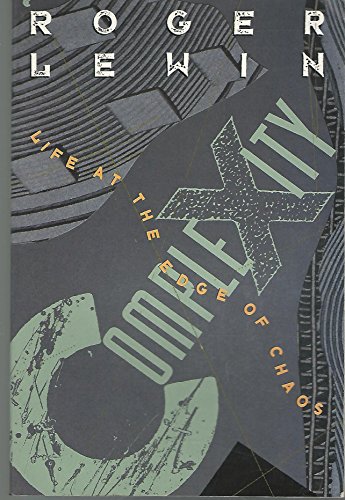
I've been thinking about order, chaos, and the "edge" between them for well over two decades, ever since I read Roger Lewin's 1992 book Complexity: Life at the Edge of Chaos. The book is about the study of "complex systems," ones that "evolve far from equilibrium at the edge of chaos. They evolve at a critical state built up by a history of irreversible and unexpected events ... 'an accumulation of frozen accidents.' "
The Earth's biosphere is just such a complex system. By dint of Darwinian evolution, our biosphere produced us, the human species.
I believe in Darwinian evolution and also in the study of complex systems as a way of enhancing Darwin's original theory. But I also believe in God. How can I reconcile my scientific understanding of evolution with my religion, I've asked myself over the decades since I first read Lewin's book and others on the same subject?
I don't really have an answer to that question. But I nonetheless maintain my belief in both God and science.
Accordingly, I believe there is hope for a restoration of meaning and sanity to our lives — even as the millennials' humor suggests otherwise.
Restoring meaning and sanity implies, to my mind, a process by which the complex system which is our society has the power to adapt itself out of the realm of chaos it finds itself in today, and back over into the evolutionarily fecund "edge" of chaos. This power, I believe, comes from God.
I think the way the millennials propagate their oddball humor online and all across the Twitterverse is, however unconsciously, a strategy by which to adapt creatively to the lunacy which the millennials perceive in the way things are today. I have faith that the millennials' viral "memes" will, in some way that's impossible to predict, rescue us all — thanks be to God!