Who remembers the Simon & Garfunkel song "At the Zoo," from the 1960s?
The musical accompaniment alone tells our ecstatic ear it's experiencing a "fine and fancy ramble," no? According to Elizabeth Bruening's "Why is millennial humor so weird?" in the Sunday, Aug. 13, 2017, Washington Post, millennials are experiencing something of a fine and fancy ramble through today's higgledy-piggledy world.
Another name for it, though, is chaos. Regarding the humor that appeals to millennials, Bruening writes of "a mood of grim, jolly absurdism," and of:
... a dream world where ideas twist and suddenly vanish; where loops of self-referential quips warp and distort with each iteration, tweaked by another user embellishing on someone else’s joke, until nothing coherent is left; where beloved children’s character Winnie the Pooh is depicted in a fan-made comic strip as a 9/11 truther, and grown men in a parody ad dance to shrill synth beats while eating Totino’s pizza rolls out of a tiny pink backpack. In this weird world of the surreal and bizarre, horror mingles with humor, and young people have space to play with emotions that seem more and more to proceed from ordinary life — the creeping suspicion that the world just doesn’t make sense.
She says:
When it comes to doubting the essential meaningfulness of the world, millennials have their reasons. Studies show that traditional sources of meaning, such as religion and family formation, are less relevant to the lives of young people than they were to our parents. The moral structure they produced has been vastly loosened and replaced with a soft, untheorized tendency toward niceness — smarminess, really, as journalist Tom Scocca put it in 2013. Long-lasting careers seem out of reach; millennials are told to go to college so they can make money, but mostly they just amass debt and then job-hop in hopes of paying it off. In the meantime, they put off getting married, having kids, buying houses and so on. And waiting feels like — well, waiting. Millennials are not engaged at work (71 percent confessed this to Gallup), they have lost faith in our political system (only 19 percent say a military takeover is unacceptable), and many are lonely (57 percent reported such in a recent Match.com survey). Millennials aren’t strictly pessimistic by any means, but the occasional tussle with feelings of emptiness and despair seems de rigueur for my generation.
Thus does she brilliantly capture and express the reasons behind the millennials' "giant race to the bottom of irony."
I see what she writes about as symptoms of societal and generational chaos. I'm using that word, "chaos," in a technical, theoretical sense, as used in the recent product of scientific inquiry, "chaos theory."
In chaos theory, chaos is understood mathematically as a feature of certain "dynamical systems" which makes them unpredictable. Apparently, a human society is such a dynamical system and can be unpredictable.
I emphasize the words "can be." Dynamical systems can also be orderly and predictable. The swinging of a clock pendulum represents an orderly, predictable dynamical system.
But other dynamical systems are chaotic and unpredictable — for example, the weather. Beyond a few days out from the present moment, we have no way of predicting what the weather will be. It's a chaotic dynamical system.
Dynamical systems can under certain circumstances change from orderly to chaotic, and vice versa. Moreover, a wide variety of dynamical systems exist in a transition zone between order and chaos called the "edge of chaos."
At or near the edge of chaos, says the Wikipedia article, "the rate of evolution is maximized." So the edge of chaos is, despite the off-putting name, a good thing.
Certain "complex" dynamical systems have so-called "self-adjusting parameters." The article says, "The prominent feature of systems with self-adjusting parameters is an ability to avoid chaos."
We humans — as individual organisms and as a society — are like many other living systems, on various scales. All such living systems are capable of "adaptation to the edge of chaos" That mouthful of jargon refers to "the idea that many complex adaptive systems seem to intuitively evolve toward a regime near the boundary between chaos and order."
This ability seems to imply, according to theorists, two things. One, a complex system that is too orderly to evolve in a way to adapt gracefully and creatively to its present circumstances can pull itself toward the fecund edge between stultifying order and chaotic impermanence. But, also, such a system can, if need be, adaptively pull itself out of the regime of chaotic impermanence and over toward the edge of chaos.
The humor and mindset of the millennials today, I judge from the Bruening article, are their creative way of adapting to what they perceive as a world of chaotic impermanence. Such a world appears to them to be absurd, to lack all meaning. How absurd is it, for example, that "millennials are told to go to college so they can make money, but mostly they just amass debt and then job-hop in hopes of paying it off"?
*****
That reference to college reminds me of something that happened while I was attending Georgetown University. It was as crazy as the millennial humor Bruening cites. In March 1967, toward the end of my sophomore year, some of us guys who worked at the student radio station, WGTB-FM, organized a joke campaign for student council president. Our candidate was a little guy who didn't even look old enough to shave, J. Frank Wilson.
J. Frank was not his real given name, but instead was borrowed from the singer who made "Our Last Date" a hit:
J. Frank, who had been reading Hitler's Mein Kampf, designed his "campaign" around certain principles stated therein. But this was, remember, a joke campaign. It had nothing — repeat, absolutely nothing — to do with anti-semitism or racism. No, the theme of J. Frank's campaign was instead "agrarian reform."
Since Georgetown is in the heart of a big city — Washington D.C. — agrarian reform made no sense whatever. That was the point.
During the week or two during which the campaign was in full gear on our Georgetown campus, we supporters of J. Frank would walk around the campus wearing identifying armbands and giving each other the J. Frank "salute":
 |
| We shouted "J. Frank" at the top of our lungs while doing this. |
The campaign rally for J. Frank had a "bread and circuses" theme. We hired an elephant from a visiting circus and had J. Frank ride it into the campus quad toward an open-air speaker's podium. At the podium, he gave a speech that was, I suppose, mostly gibberish. (I don't remember any of it.) Then J. Frank, who was wearing just swimming trunks, wallowed around in a child's wading pool filled with elephant dung. Then he set himself on fire (using a chemical that would visibly produce flames would not burn his skin, I should add).
One of J. Frank's opponents in the race for student council president was named Bill Clinton. You may remember Bill Clinton from the eight years he served as President of the United States. Well, Bill Clinton lost this particular election at Georgetown University (see here). He had won the student council presidency twice before, but now he was defeated by another candidate — not J. Frank, but a guy named Terry Modglin. As I recall, J. Frank came in third in a race that featured several other candidates.
J. Frank's campaign was actually, though we didn't think of it this way at a time, a tribute to absurdity and chaos in the world as we experienced it. My point here is that even as far back as the late 1960s, there was incipient chaos in the life experience of America's youth.
*****
Now for the promised religious part of the discussion:
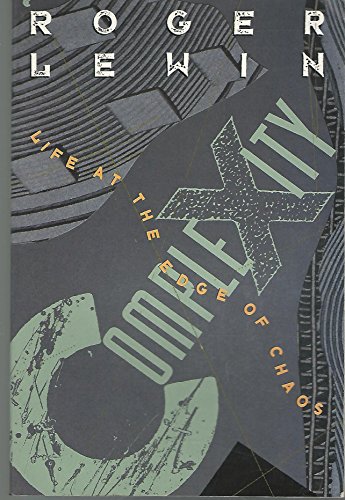
The Earth's biosphere is just such a complex system. By dint of Darwinian evolution, our biosphere produced us, the human species.
I believe in Darwinian evolution and also in the study of complex systems as a way of enhancing Darwin's original theory. But I also believe in God. How can I reconcile my scientific understanding of evolution with my religion, I've asked myself over the decades since I first read Lewin's book and others on the same subject?
I don't really have an answer to that question. But I nonetheless maintain my belief in both God and science.
Accordingly, I believe there is hope for a restoration of meaning and sanity to our lives — even as the millennials' humor suggests otherwise.
Restoring meaning and sanity implies, to my mind, a process by which the complex system which is our society has the power to adapt itself out of the realm of chaos it finds itself in today, and back over into the evolutionarily fecund "edge" of chaos. This power, I believe, comes from God.
I think the way the millennials propagate their oddball humor online and all across the Twitterverse is, however unconsciously, a strategy by which to adapt creatively to the lunacy which the millennials perceive in the way things are today. I have faith that the millennials' viral "memes" will, in some way that's impossible to predict, rescue us all — thanks be to God!


No comments:
Post a Comment