The sciences of chaos and complexity help confirm this. Here's a brief rundown on why.
A human society is what scientists and mathematicians call a "nonlinear dynamical system." As such, it generally operates in an orderly way, although certain things can push it over into chaos.
Here's a drawing, called a "bifurcation diagram," that appears in James Gleick's book Chaos. The book is a layman's intro to chaos theory. Gleick shows how nonlinear systems can be pushed from a orderly state into chaos. This bifurcation diagram illustrates how this can happen:
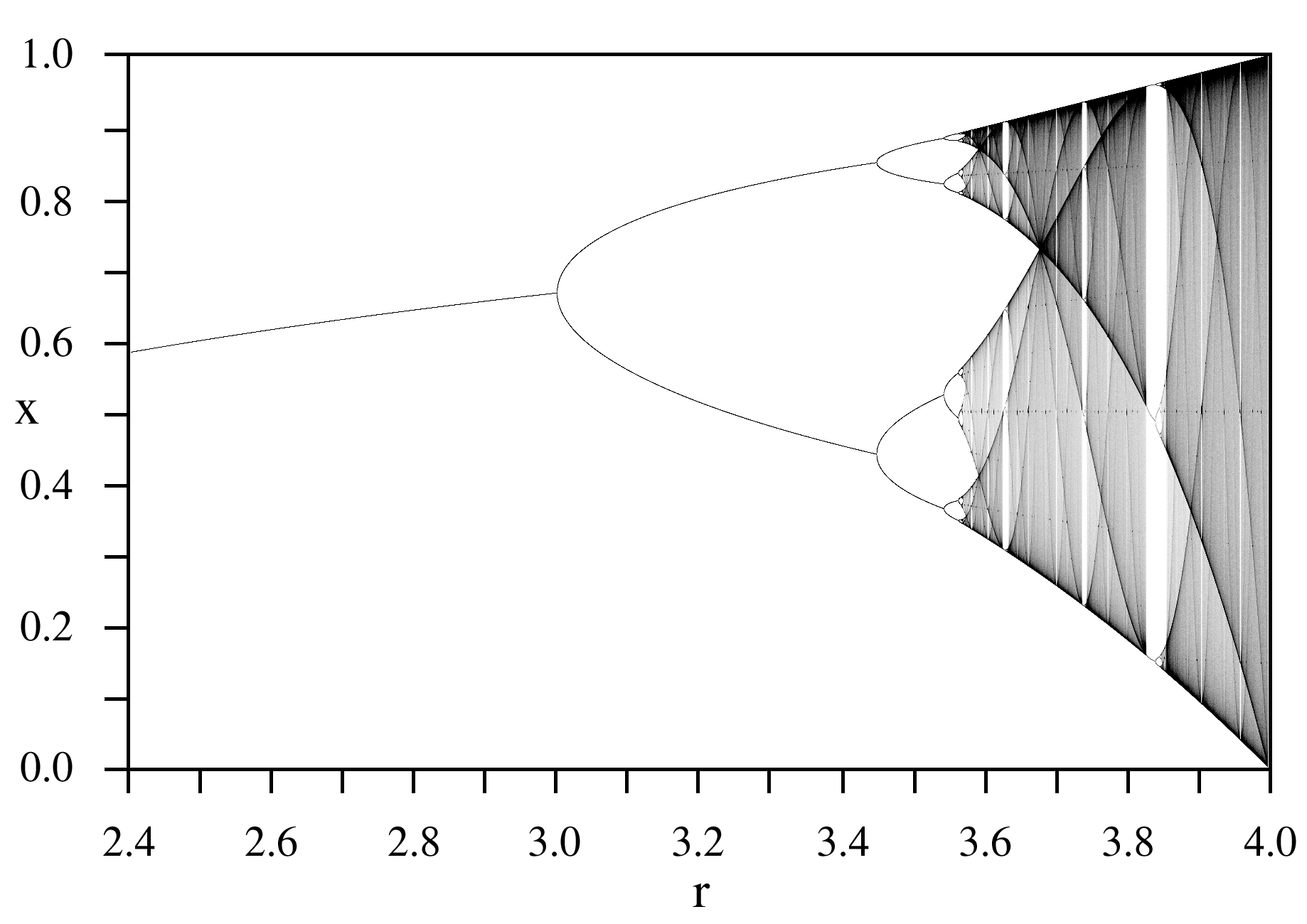
Look at the bottom axis, labeled r. r represents numbers that increase from 2.4 on the left to 4.0 on the right. The vertical axis, x, represents a value that depends on r and changes over time as r itself changes.
If r gets too big for whatever reason, the orderly behavior represented on the left of the diagram for values of r that are less than about 3.6 deteriorates. Here in the r >= 3.6 area we see the onset of chaos. The dark areas to the right of the diagram are simply graphical illustrations of what chaotic behavior looks like.
Notice that as r goes up — starting at about the value 3.0 — the orderly part of the diagram begins to "bifurcate." It splits, then splits again, then again. We're entering the region where chaos is imminent. If r continues to ascend, chaos is inevitable.
We're in that perilous region right now in America.
Think of "bifurcation" as what happens when different parts of a system begin to split apart in response to some external or internal stimulus. This splitting apart is the opposite, in the world of scientific abstractions, of "setting aside our differences" in the practical world. It represents the rise of disunity, not unity.
As disunity rises, chaos looms. I think the healing message of Jesus in the New Testament was intended by him as an antidote to societal and personal chaos in human affairs.
Even so, as I said in the earlier post, it's so difficult to see the sense of that wisdom, is it not? We're currently reeling from the news of a killing at a Charlottesville, Virginia, rally involving a white supremacist plunging his car into a group of counter-protesters, killing one and injuring several. White supremacism, the KKK, neo-Nazi belief — they're all as wrong as wrong can be. But I think a lot of the reaction to the Charlottesville tragedy, among conservatives and especially among progressives, has been to curse the darkness — represented in large part by lambasting President Trump's failure to impugn white supremacism expressly in his initial comments — rather than to light a candle.
We who hate what they espouse need to dialogue with white supremacists, not cast them into outer darkness. Dialogue heals. Dialogue moves us away from the onset of chaos.
True as that may be — and I believe it is true — seeking dialogue with KKK'ers feels like the last thing most of us want to do in the wake of Charlottesville, right? Maybe we should follow the example of Daryl Davis, a black musician I recently took a lecture course from. Daryl has spent years befriending KKK people and nudging them (often successfully) in the direction of his mantra: "How can you hate me if you don't even know me."
It's been dialogue that has allowed Daryl and his (yes!) friends in the KKK to get to know and even like one another. Here's a video about that:
(Notice that it's also a video about how music can serve as a "common denominator" between blacks and whites. I'm currently in the process of developing a course I'm calling "Ebony and Ivory" that I hope will show that common denominator in action down through American history.)


No comments:
Post a Comment